
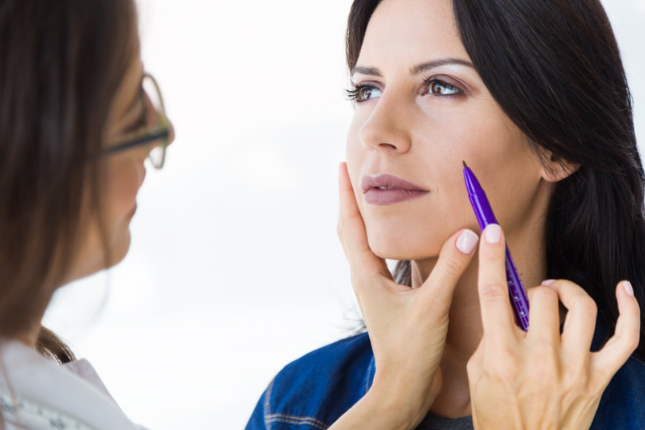
Sagging along the jawline, cheeks that don’t sit quite where they used to, a softening jaw contour these are the concerns that usually bring people to ask about non-surgical facelifting. Thread lifts and HIFU (High-Intensity Focused Ultrasound) are the two most commonly recommended options, and while both promise to counter sagging without surgery, they work through genuinely different mechanisms. Understanding that difference is the key to choosing the one that actually matches your concern.
How They’re Fundamentally Different
Thread lift is a minimally invasive procedure where absorbable sutures (typically PDO, PLLA, or PCL material) are inserted under the skin and used to physically reposition sagging tissue, pulling it upward and anchoring it in place. This gives an immediate, visible lift. Over the following months, the threads also trigger a mild collagen-building response along their path as the material gradually dissolves — usually within 6–9 months — leaving some lasting structural support behind even after the thread itself is gone. Thread Lift Treatment in Hyderabad
HIFU is a completely non-invasive energy treatment. It delivers focused ultrasound energy to deep skin layers, heating tissue to stimulate the body’s own collagen production. There’s no physical repositioning — the lift comes gradually, as new collagen firms and tightens the skin over the following months.
In short: thread lift delivers “lift first, tighten second.” HIFU delivers “tighten first, lift second.”
Which One Suits Which Concern
Significant sagging or drooping (moderate to advanced jowls, deep nasolabial folds)
Thread lift tends to be the better fit, because it physically repositions tissue rather than relying purely on gradual collagen tightening — which has real limits on how much sagging it can correct.
Mild to moderate skin laxity, early jawline softening
HIFU is often the more appropriate option here, since the concern is more about skin quality and mild firmness loss than actual drooping that needs to be physically lifted.
Wanting to see a result immediately
Thread lift gives a visible lift right after the procedure. HIFU’s results build gradually over 2–3 months as new collagen forms there’s no dramatic “reveal” moment.
Wanting the least invasive option
HIFU is entirely non-invasive (no cuts, no sutures under the skin). Thread lift, while minimally invasive, does involve inserting material under the skin, which carries a slightly higher (though still low) complication profile than HIFU.
Results Timeline and Longevity
| Thread Lift | HIFU | |
| When you see results | Immediate lift after the procedure | Gradual, visible over 2–3 months |
| How long results last | Typically 1–3 years | Typically 12–18 months, often needing annual maintenance |
| Downtime | Mild swelling/bruising for a few days to a week | Minimal — most people return to normal activities same day |
| Best suited for | Moderate to significant sagging needing repositioning | Mild laxity and overall skin tightening/quality |
| Repeat treatment | Can be redone as threads dissolve | Usually annual maintenance sessions |
Can They Be Combined?
Yes — a common approach for people with both mild-to-moderate sagging and a desire for improved skin quality is to use threads for the areas needing actual repositioning, combined with HIFU for broader tightening and firmness. Many dermatologists also use a phased strategy: non-surgical treatments (HIFU, threads) to maintain and improve skin quality through the 30s and 40s, potentially delaying the need for surgical intervention later, or refining results after surgery if that’s eventually chosen.
What Neither Treatment Can Do
Neither thread lift nor HIFU replicates the results of a surgical facelift — both work within the limits of non-surgical technology, meaning the degree of change is more subtle and works best for mild-to-moderate concerns rather than advanced sagging. If expectations are set around a dramatic, surgery-level transformation, either treatment is likely to disappoint; set realistically, both can produce a genuinely refreshed, natural-looking result.
Safety Considerations
- Thread lift should be performed by an experienced, appropriately trained dermatologist — thread placement depth and technique significantly affect both results and complication risk (irregularities, thread visibility, or asymmetry are typically technique-related issues)
- HIFU energy settings need to be calibrated to the individual’s skin thickness and concern area — generic, one-setting-for-everyone protocols are less likely to give a good result
- Both treatments require a proper consultation to assess whether your specific concern (sagging vs. laxity vs. both) matches what each technology is actually designed to address
The Derm Aura Approach
At Derm Aura Skin & Hair Clinic, Banjara Hills, Dr. Suma Divya evaluates the specific pattern of sagging or laxity in your face before recommending thread lift, HIFU, or a combination — rather than defaulting to whichever treatment is being promoted, since the two solve genuinely different problems.
Frequently Asked Questions
Is thread lift or HIFU better for jowls? For moderate to significant jowl sagging, thread lift is usually more effective since it physically repositions the tissue. HIFU is better suited to milder laxity where firming, not repositioning, is the main need.
How long do thread lift results last compared to HIFU? Thread lift results typically last 1–3 years. HIFU results generally last 12–18 months, with many people opting for annual maintenance sessions.
Which has less downtime, thread lift or HIFU? HIFU has minimal to no downtime. Thread lift typically involves mild swelling or bruising for a few days to a week.
Can I combine thread lift and HIFU? Yes — many treatment plans use threads for areas needing physical repositioning and HIFU for overall skin tightening and quality improvement.
Will thread lift or HIFU give results as dramatic as a surgical facelift? No — both are designed for mild-to-moderate concerns and work within the limits of non-surgical technology. A surgical facelift remains the option for more advanced sagging or a more dramatic, longer-lasting transformation.